An all-in-one financial operations tool for SMB and corporate clients — consolidating accounts, transfers, direct debits, mass payouts, and FX into a single, calm interface. Designed to replace four tabs with one.
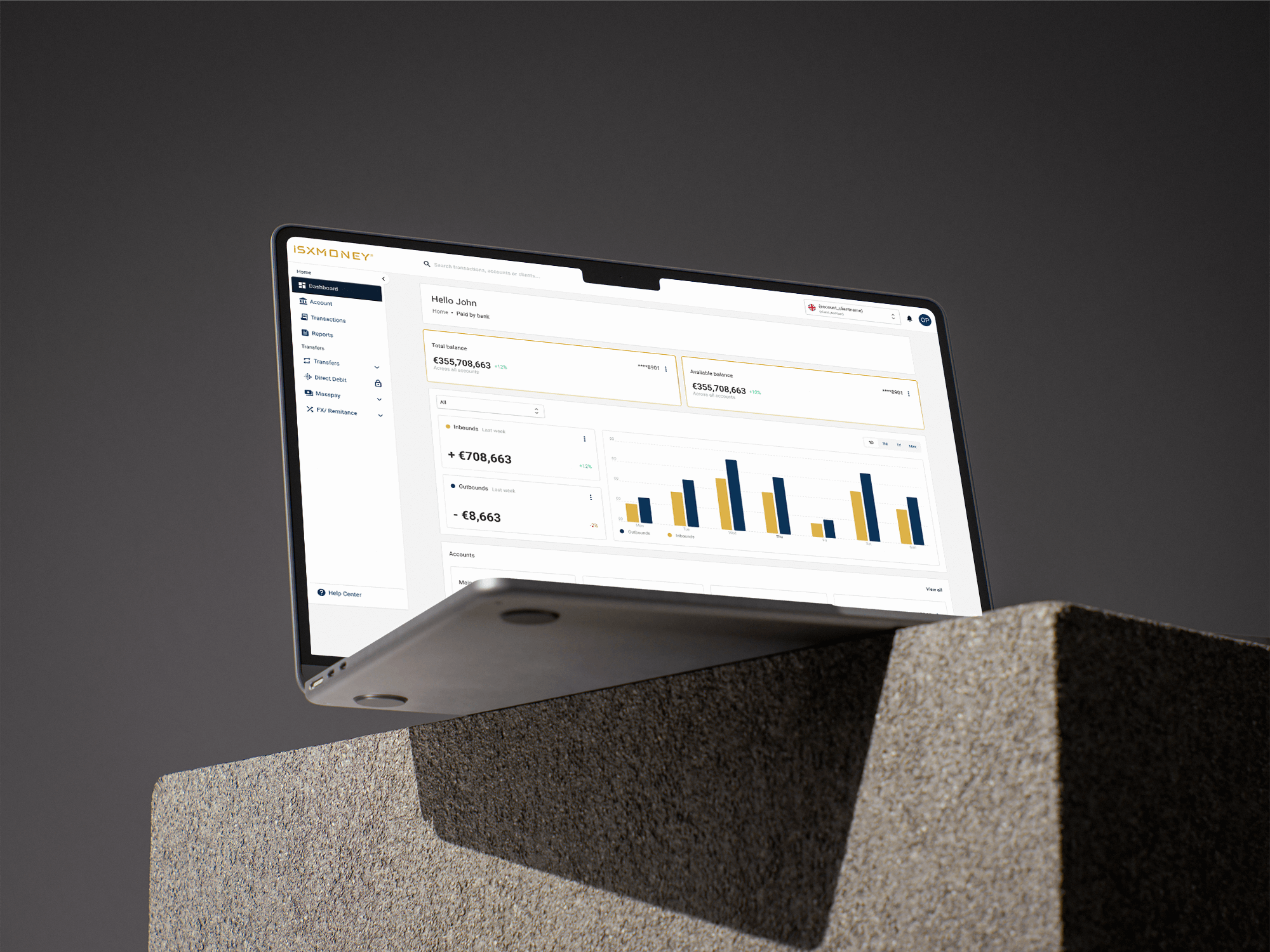
iSX Money serves finance teams who move large volumes through multiple accounts and currencies. They were doing it across four disconnected products — and bouncing between them was costing them hours every week.
I led the design of the unified platform, from information architecture and the component library to the production-ready dashboard. The work covered the home view, accounts, transactions, transfers, direct debit, Masspay (bulk payments), and FX/remittance — each with its own data shape and edge cases.
Most B2B fintech research is interview-only. I pushed for contextual inquiry: sitting with 6 finance teams during their actual end-of-month process. We recorded screens, counted clicks, and timed tasks.
Users exported CSVs from our tool, did the actual thinking in Excel, then re-uploaded results. The dashboard was a courier, not a workspace.
Every user we observed double-checked numbers against a calculator or another tab. Currency formatting, rounding rules, and timestamps mattered enormously.
Almost every meaningful action was a two-person job. The product needed maker-checker built in from the floor up, not bolted on.
Finance leads checked balances on their phone during meetings, but no one was ever going to set up a 200-row Masspay batch on a 6" screen.
We restructured the IA around roles ("I want to see my money" / "I want to move my money" / "I want to prove what happened") rather than around backend products. The sidebar reads: Dashboard, Account, Transactions, Reports, and then a Transfers group containing Transfers, Direct Debit, Masspay, and FX.
Every transfer flow shares the same skeleton — source, beneficiary, amount, purpose, review, confirm — so muscle memory transfers between them. The data tables share one component, one set of filters, one export pattern.
The product is the data table. In B2B fintech, the table is the canvas. If your table works — fast, filterable, exportable, role-aware — most users will forgive a lot elsewhere.
Onboarding sessions matter as much as launch. We built a 6-week rolling intake program where I sat in on every new-customer kickoff. Each one produced 2–3 fixes that shipped within the next sprint.
Numbers need rules, not just styles. A "currency token" in the design system has to cover formatting, rounding, locale, screen-reader output, and what happens at zero. That's a design system asset, not a Figma component.