Case study 02iSX MoneyB2B money transfer · Desktop
Four products, one calm workspace.
An all-in-one financial operations tool for SMB and corporate clients. It brings accounts, transfers, direct debits, mass payouts and FX together in a single interface.
- Role
- Lead Designer
- Company
- ISX Financial
- Team
- 3 designers, 9 engineers, 2 PMs
- Platform
- Web, desktop-first
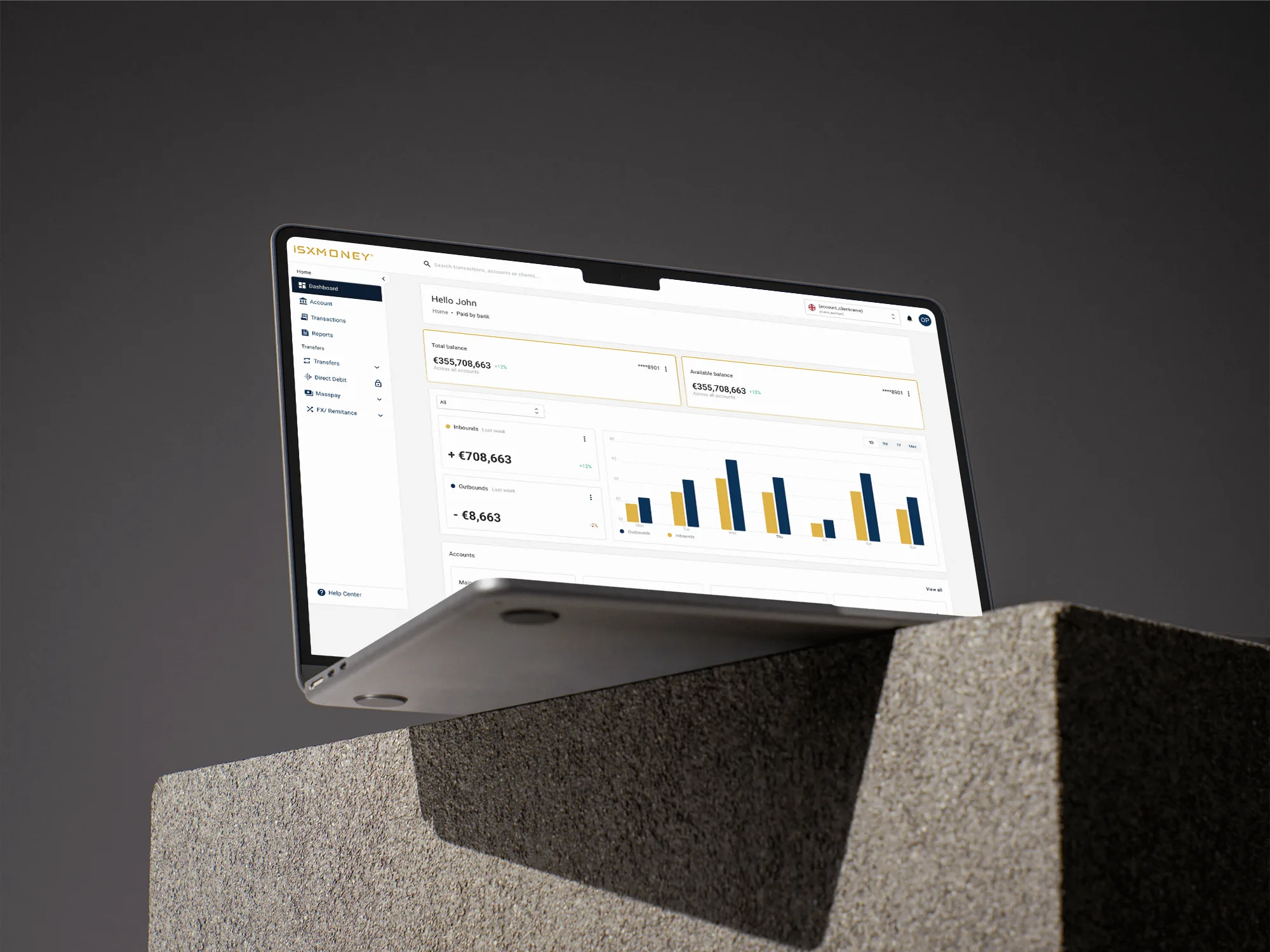
One platform, every account, in any currency.
Finance teams were moving money across four disconnected products, and switching between them cost hours every week.
I led the design of the unified platform, from information architecture and the component library to the production-ready dashboard. It covered the home view, accounts, transactions, transfers, direct debit, mass payouts and FX, each with its own data shape and edge cases.
Four products held together by browser tabs.
Before
- Separate logins for accounts, transfers, FX and payouts
- Inconsistent terms: Beneficiary, Recipient and Payee
- No unified balance view, so users tallied totals in spreadsheets
- Manual data entry repeated across products
- Audit trail scattered across exports and emails
After
- One login, one navigation, one design language
- A central beneficiary book reused in every flow
- Real-time balance across all accounts and currencies on the home screen
- Smart defaults: last-used currency, recent beneficiary
- A unified activity log with filters, exports and audit-ready receipts
What I owned, and what the team owned.
My contribution
- Design lead for the unified platform
- Information architecture and navigation model
- Component library: data tables, transfer skeleton, currency tokens
- Contextual inquiry with finance teams
- Production-ready dashboard specs
Wider team
- Two designers working on flows within the system
- Build: 9 engineers across the four product areas
- Roadmap and scope: 2 PMs
Watching finance teams do the real work.
Most B2B fintech research is interview-only. I pushed for contextual inquiry: sitting with finance teams during their actual end-of-month process while we recorded screens, counted clicks and timed tasks.
The work happens in spreadsheets.
Users exported CSVs, did the thinking in Excel, then re-uploaded. The dashboard was a courier, not a workspace.
Trust is built one decimal place at a time.
Everyone double-checked numbers. Currency formatting, rounding and timestamps mattered enormously.
One person types; another approves.
Almost every meaningful action needed two people, so maker-checker had to be built in from the start.
Mobile is a glance, not a workflow.
Leads checked balances on their phones in meetings, but nobody sets up a payout batch on a 6-inch screen.
A navigation model that matches how money actually moves.
The IA is organised around intent rather than backend products: see my money, move my money, prove what happened. Every transfer flow shares one skeleton (source, beneficiary, amount, purpose, review, confirm), so muscle memory carries over between them.
Inside the platform.
Select any screen to enlarge.
A single source of truth for finance teams.
The platform replaced four separate tools with one login and one design language. The table, transfer and currency patterns went into the shared design system.
What this taught me about B2B fintech.
- The product is the data table.If the table is fast, filterable, exportable and role-aware, users will forgive a lot elsewhere.
- Onboarding sessions matter as much as launch.Sitting in on new-customer kickoffs produced fixes that shipped within the next sprint.
- Numbers need rules, not just styles.A currency token must define formatting, rounding, locale, screen-reader output and zero states.